Key takeaways
- Claude Fable 5.2 scored 85% overall in CaseVBench v6, second of 22 models. Only GPT-6 Astra scored higher, at 92%.
- It is the fastest and cheapest model in the top three. Its median time was 8.8 seconds, and its median cost was $0.079 a page.
- It found 535 of the 557 callouts and all 166 floor plans in the test set.
- It found 46 of the 90 countertops, about half.
Why we tested Fable 5.2 as soon as it came out
We run CaseVBench every few weeks to test how well AI models read architectural drawings. The November run (v6) went live on November 12 with 22 models. That run included two new models: Claude Fable 5.2 and Gemini 4 Carbon.
Fable 5.2 went straight to second place, behind only GPT-6 Astra, and it got there while being the fastest and cheapest model in the top three. Its predecessor, Claude Fable 5.1, scored 70% and sits seventh.
What is CaseVBench?
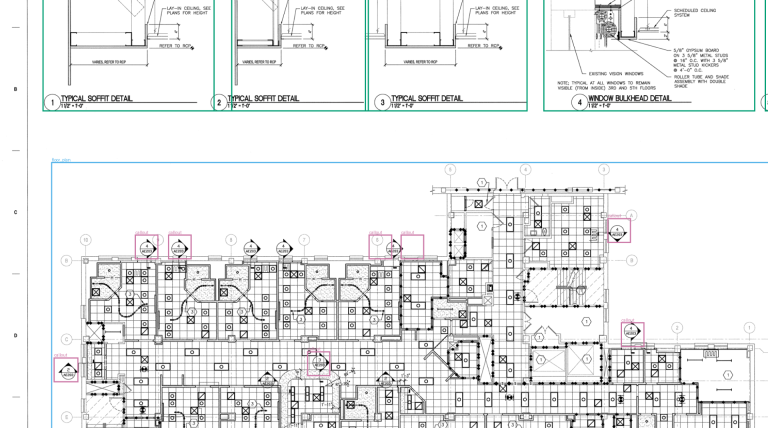
CaseVBench is COXIT’s benchmark, a test of how well AI models find objects on architectural drawings. Each model gets a drawing page and must draw boxes around five types of objects. These are cabinets, countertops, floor plans, elevations and callouts, the small reference bubbles and tags that point to other sheets.
We compare those boxes with boxes an expert drew on the same page. A box counts as a match when it overlaps the expert’s box by at least half. We use the matches, misses and extra boxes to calculate a score for each object type. We also calculate an overall score from 0 to 100 using those same results.
The test set has 119 pages from 9 real projects, and every model sees the same pages. Read how the score is calculated.
Where Fable 5.2 sits in the top five
Fable 5.2 is 7 points behind GPT-6 Astra overall, but it is three times faster and costs less than half as much per page.
| Model | Rank of 22 | Overall score | Cost per page | Time per page |
|---|---|---|---|---|
| GPT-6 Astra | 1 | 92% | $0.186 | 28.2 s |
| Claude Fable 5.2 | 2 | 85% | $0.079 | 8.8 s |
| Gemini 4 Carbon | 3 | 83% | $0.108 | 66.6 s |
| Claude Opus 5.5 | 4 | 79% | $0.040 | 8.9 s |
| Gemini 4 Argon | 5 | 76% | $0.021 | 9.8 s |
Cost and time are medians per page, meaning the middle values in the test. Gemini prices use the standard rate.
Of all 22 models, only Claude Sonnet 5.5 is faster than Fable 5.2, and Sonnet scores 51% overall. At the median page cost, 1,000 pages would cost about $79 in model fees with Fable 5.2, against $186 for GPT-6 Astra. Claude Opus 5.5 is cheaper still at about $40, but it scores 6 points lower.
Fable 5.2’s score changes a lot from one object to the next, so we looked at each object type to see where those differences would affect review work.
What Fable 5.2 found on each object type
The first table gives Fable 5.2’s score on each object and its rank among the 22 models.
| Object | Fable 5.2 score | Rank of 22 | GPT-6 Astra | Gemini 4 Carbon | Claude Opus 5.5 |
|---|---|---|---|---|---|
| Cabinets | 71% | 3 | 82% | 74% | 60% |
| Countertops | 55% | 2 | 84% | 49% | 51% |
| Floor plans | 98% | 3 (joint) | 99% | 99% | 91% |
| Elevations | 87% | 8 (joint) | 94% | 83% | 90% |
| Callouts | 94% | 2 | 96% | 89% | 84% |
Each score combines two kinds of mistakes: objects the model missed and boxes it drew on nothing. Those mistakes create different work for an estimator, because a missed cabinet is missing from the quote. An extra box, meanwhile, is something a person has to find and delete during review. So we also counted both kinds of mistakes across all 9 projects in the test. These counts do not appear on the benchmark page.
| Object | Expert’s objects | Found | Missed | Extra boxes |
|---|---|---|---|---|
| Cabinets | 317 | 239 | 78 | 115 |
| Countertops | 90 | 46 | 44 | 30 |
| Floor plans | 166 | 166 | 0 | 7 |
| Elevations | 300 | 245 | 55 | 21 |
| Callouts | 557 | 535 | 22 | 49 |
Fable 5.2 missed only 22 of the 557 callouts, the small bubbles and tags that fill busy sheets. Only GPT-6 Astra scores higher on callouts.

Floor plans are another strong result, and the top models have almost solved this task. Fable 5.2 drew boxes around every one of the 166, with 7 extra boxes.
Elevations are also a solid result, though Fable 5.2 does less well here compared with other models. It found 245 of 300 and drew only 21 boxes on nothing. Still, seven models score higher on elevations, including Claude Opus 5.5.
Cabinets bring more review work because the extra boxes pile up there. Fable 5.2 found 239 of 317, and its cabinet score is third best, after GPT-6 Astra and Gemini 4 Carbon. But it also drew 115 boxes that matched no cabinet, leaving people to delete them when reviewing cabinet counts.

Countertops: 46 of 90 found
Countertops need even more review. In CaseVBench they are the lowest-scoring object for 16 of the 22 models. These long, thin shapes run along the top of base cabinets and often share lines with the cabinets below.
Fable 5.2 found 46 of the 90 countertops, so it missed about half of them. It also drew 30 countertop boxes that matched nothing. Even so, its score of 55% is the second best of 22 models, which shows how hard countertops are for every model. GPT-6 Astra is far ahead at 84%.
Those misses matter for a shop that prices countertops by length when preparing a quote. A model that misses about half the countertops cannot produce the countertop line on its own. That leaves a person to go through every elevation.
How tight the boxes are
Finding an object and drawing a tight box around it are two different skills. Our standard rule asks for at least half overlap with the expert’s box. For the top five models, we also calculated the score under stricter overlap rules to check how closely the boxes fit.
| Model | Overlap 0.50 (standard) | 0.75 | 0.90 |
|---|---|---|---|
| GPT-6 Astra | 91.6% | 75.9% | 44.1% |
| Claude Fable 5.2 | 85.4% | 59.6% | 29.3% |
| Gemini 4 Carbon | 83.4% | 53.8% | 28.6% |
| Claude Opus 5.5 | 78.8% | 48.6% | 25.1% |
| Gemini 4 Argon | 75.7% | 46.8% | 25.6% |
All five scores drop as the rule gets stricter, and Fable 5.2 keeps second place of the five at each level. But its gap to GPT-6 Astra more than doubles at 0.75 overlap, where Fable 5.2 scores 59.6% against 75.9%. Fable 5.2 is close to the leader when boxes only need to point someone to the right spot on a sheet. For measuring lengths straight from the boxes, GPT-6 Astra’s boxes fit more tightly.
The fit of the boxes is only part of the picture, because results also vary by project. Fable 5.2 scored almost 100% on one project and 63% on its hardest one. That project was also the hardest for Gemini 4 Carbon. So an average over 9 projects cannot tell you how a model will do on your drawings.
One version later: what changed from Fable 5.1
We tested Fable 5.1 on the same 119 pages, so we can see what one version changed. The overall score went from 70% to 85%, most of the gain came from callouts (64% to 94%), and the cost per page roughly halved.
Fable 5.2 is the cheapest and fastest of the top three. It still misses about half the countertops, though. On those, a person checks every elevation.
Volodymyr Hresko, co-founder of COXIT
What to expect if you upload your own drawing set to Fable 5.2
On drawings like the ones in our test, Fable 5.2 missed none of the 166 floor plans and 22 of the 557 callouts, so those come back almost complete. Cabinets need more care. It found 239 of 317 and also drew 115 boxes on things that were not cabinets, so a cabinet count taken straight from the model can be wrong in both directions. It found 46 of the 90 countertops, so plan to check every elevation for those yourself. Results also change from set to set, from almost 100% on one project to 63% on its hardest. The boxes show where an object is rather than its exact size, so don’t measure lengths from them. Our numbers come from sending each page to the model on its own, with the same instructions every time. Uploading a whole PDF into a chat window is a different setup, and these numbers don’t carry over to it.
What this means for teams that read drawings
At the median page cost, 1,000 pages cost about $79 in model fees with Fable 5.2. The rest of the cost is the person checking the boxes, and how much checking depends on the object. Fable 5.2 does best on callouts and floor plans, and does well on elevations and cabinets. But countertops still need a person to check them.
So it makes sense to plan the review around the object. For callouts and floor plans, a reviewer mostly confirms what the model found. For cabinets, they also delete extra boxes, while countertops need checks of every elevation because about half are missed.
The model you tested last time may also not be the model you would get today. Before deciding for or against a model, test it on your own drawings, and test again when a new version comes out. That is how we build our custom AI takeoff tools, with the model as one part we can swap when a better one arrives.
For a direct comparison of Claude and GPT models, see ChatGPT or Claude for architectural drawings. For Google’s models, see our reviews of Gemini 4 Argon and Gemini 4 Carbon.
Methodology and full results
The numbers in this post come from CaseVBench v6, published November 12, 2026. We tested 22 AI models on 119 architectural drawing pages, comparing their boxes with expert boxes. Those pages came from 9 projects, and we scored matches at 0.50 overlap. Cost and time are medians per page, while found, missed and extra-box counts combine results from all 9 projects.