Manufacturing
review on Clutch




Insights from 40 AWI members on AI adoption, operational challenges, and where automation can deliver the most value in woodworking operations.


Understand how shops currently use digital tools, automation, and AI in their estimating and operational workflows.
See which tasks consume the most time — including change orders, submittals, manual takeoffs from drawings, and data entry.
Discover which processes are best suited for AI automation and what companies want to learn before adopting AI solutions.
Learn how one casework manufacturer reduced estimating time from hours to minutes using a custom AI solution.
Key takeaways from industry experts on preparing data, validating AI systems, and choosing the right problems to solve first.
What 40 architectural woodwork manufacturers said about where AI actually fits in their operations — and what is still stopping them.
Half the shops use digital tools like Cabinet Vision or Bluebeam, but only 1 in 5 have started using AI. There is a significant gap between current technology use and AI implementation.
Two-thirds of respondents identified change orders and revisions as their biggest time drain. Submittals and specification documents come second. These document-heavy tasks are prime candidates for automation.
The top question is not "what can AI do" but "can we trust it?" The industry wants proof that AI reads drawings accurately, and wants to understand how to validate reliability before investing.
Estimation time has dropped from hours to minutes in real implementations. But success depends on defining the problem clearly first.
Companies that calculate real costs, ensure their processes are repeatable and data-rich, and plan for proper testing see better outcomes than those who jump straight to technology.
Respondents could select more than one option, so the figures total more than 100%.
Key finding. Half the industry uses digital tools, but most workflows still require significant manual work. Only 1 in 5 shops are actively using AI.
Respondents could select more than one option, so the figures total more than 100%.
Key finding. Change orders and paperwork consume the most time, affecting two-thirds of respondents.
Respondents could select more than one option, so the figures total more than 100%.
Key finding. Accuracy and reliability are the top concerns. The industry wants proof that AI works before investing.
Asked as an open question, then grouped into themes.
Key finding. Estimating and takeoffs dominate, with over a third of respondents naming it as their top issue. The remaining responses split evenly, at 12–14% each, across document processing, shop drawings, scheduling, organisation and systems, and other.
Not sure where to start with AI, but reducing errors in take-offs and estimating from architectural drawings is the thing I am most interested in learning about.
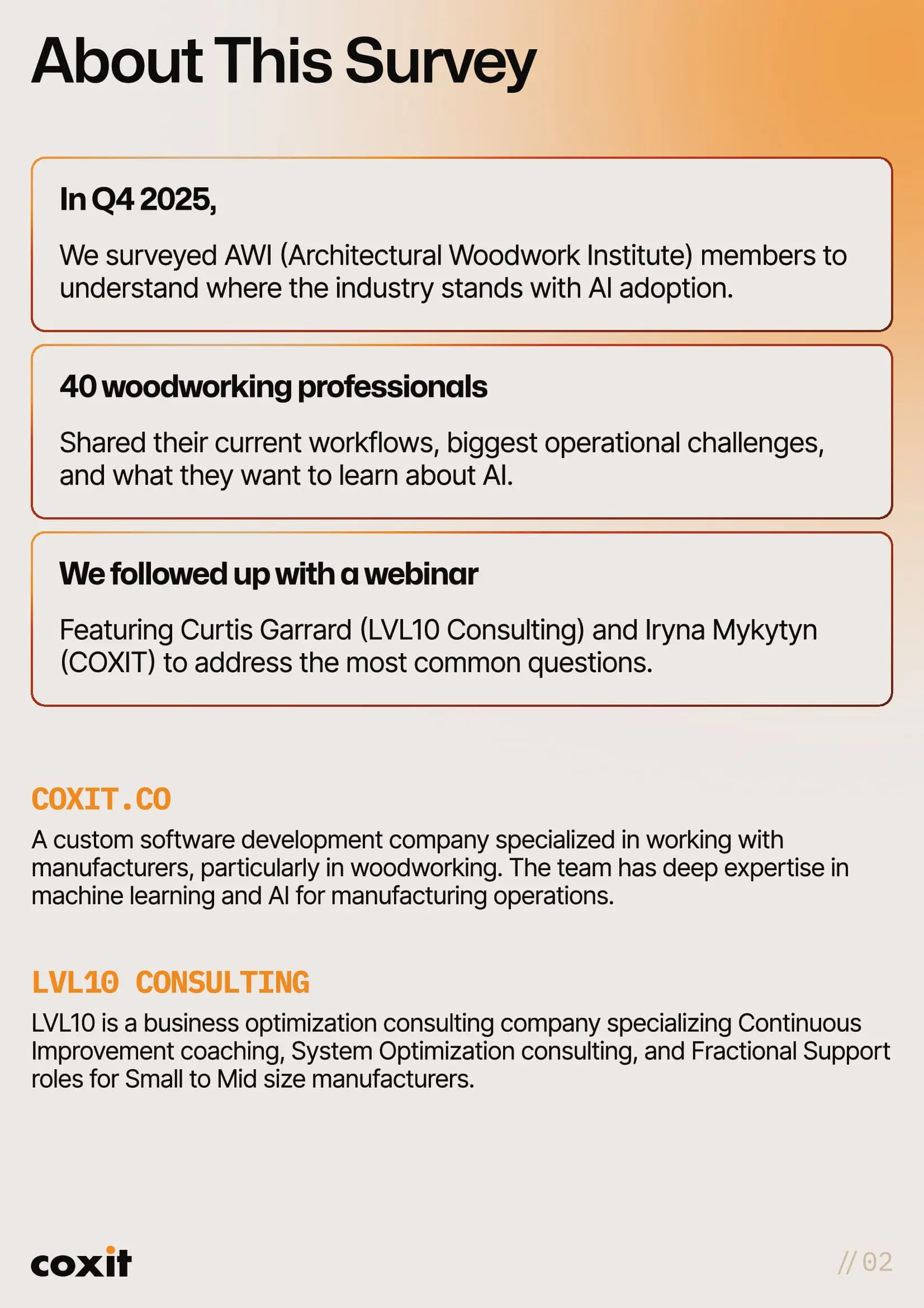
Following the survey, COXIT and LVL10 Consulting ran a webinar addressing the questions raised most often by respondents.
Founder, LVL10 Consulting
On the preparation work that happens before any technology gets built. Most AI projects fail not because of bad technology, but because companies skip this step.
Founder, CEO & CTO, COXIT
On the technical side of implementation, and what actually matters when building systems for woodworking operations.
These are the full findings. The designed PDF — including the Stevens Industries case study and the document-agent walkthrough — is available below.

Tell us a bit about your project or challenge, and we'll get back to you shortly.
Reach out directly
[email protected]