Hey there,
I don’t know about your September, but mine flew by. We had a ton of work. It feels like everyone decided to build something at the same time.
And you know what comes with a lot of work — failures. Because the only way to avoid failing is to do nothing at all. So yeah, failures happen. I want to tell you about one of ours.
I met a lot of AI engineers who don’t accept offers
Let me start with our biggest challenge this month. We had an open position for an AI Engineer. Over 200 candidates were sourced, and the process looked like this:
- 10% invited to screening (20 candidates)
- 80% passed internal screening (16)
- 50% selected for client interviews (8)
- 2 offers made
- 0 accepted
Zero. Not a single one. Both offers fell through — one candidate accepted another opportunity, and another suffered an injury right after the interview and couldn’t commit to a start date. Our client needed this position filled urgently and wanted to ensure future candidates wouldn’t back out after receiving an offer. We couldn’t afford to lose more time, so we changed the process.
How our process works
At COXIT, every outstaffing engagement follows a transparent flow:
- Recruiter screening. Each candidate goes through a structured interview. We collect background, expectations, and motivation, and record a Loom video so the client can review quickly and make informed decisions.
- Notion workspace. All profiles, videos, and evaluations are shared in Notion, allowing the client to review, rate, and comment in real time.
- Client interview → offer → test period. Once approved, we handle all contracting, onboarding, and test period coordination.
Normally this results in smooth placements and high acceptance rates. But given the urgency and back-to-back drop-offs, we reinforced the system to make it fail-proof.
What we changed
- Senior Delivery Manager involvement. A Delivery Manager now joins after screening to double-check motivation, confirm timing, and communicate project context directly.
- Re-verification before every key step. Before each interview and before the offer, we confirm candidate availability, competing offers, and commitment.
- Real-time feedback loops. Instead of asynchronous email updates, we now hold short alignment calls with the client to adjust the search direction immediately.
- Backup shortlist. For urgent positions, we maintain a vetted reserve of candidates ready to start if an offer falls through.
On the bright side: the team is growing
On a much more positive note, we onboarded a fractional CTO, Serhii Herasymov. Serhii has over 15 years in software development, most of it as a Solution Architect and CTO. He’s scaled engineering teams from zero to 300+ people and helped companies move from small dev shops to serious technology businesses. His focus is on strategic planning, organizational structure, and making sure business goals actually align with what’s technically possible — so we can grow and take on more ambitious projects.
We’re also close to full AWS certification. I personally earned two AWS certificates this month. It’s proof that we’re serious about cloud infrastructure and know what we’re doing.
The questions clients keep asking
September was busy partly because we had a lot of discovery calls. Two of them really stood out because they show a pattern we’re seeing more and more.
First, I talked with a company that participates in government and corporate tenders. Every time they want to bid, they receive massive documents — 50 to 200 pages of requirements, product lists, specifications. Someone on their team has to sit down and manually go through everything to extract what products are needed, how many of each, what sizes, what materials, all the technical details.
What they can do instead: use LLMs to read through Word and PDF files automatically and extract all the relevant information into structured tables.
Second, a legal team working with contracts and agreements. When contracts get revised, changes are marked — deleted text in red, new clauses highlighted, modifications underlined. Their lawyers have to read through 30, 50, sometimes 100-page documents to find every single change and make sure nothing important slipped through.
What they can do: use technology that can read the document and analyse its formatting, detecting colours, highlights, and other visual markers. The system identifies modifications and generates a list of all changes.
Different industries, different documents, but the same core problem: people spending hours extracting structured information from messy files. This is where most real AI projects actually happen — solving repetitive problems that waste smart people’s time. Yes, LLMs are typically the answer to these questions, but how you use them very much depends on your specific business needs. Which brings me to the article I want to share with you.
“Faith in God-like large language models is waning”
The Economist recently published an article with that title, and as a business owner myself I completely agree with the reality check.
The article makes a good comparison: the early days of ChatGPT felt like the iPhone launch in 2007. Revolutionary. But now? AI advances feel more like incremental phone upgrades. GPT-5 got about the same reaction as the new iPhone 17 — a collective shrug.
Two points from the article resonated. One, companies are shifting from “spend whatever it takes” to focusing on actual ROI. As one VC in the article put it: you may need a Boeing 777 to fly from San Francisco to Beijing, but not from San Francisco to Los Angeles.
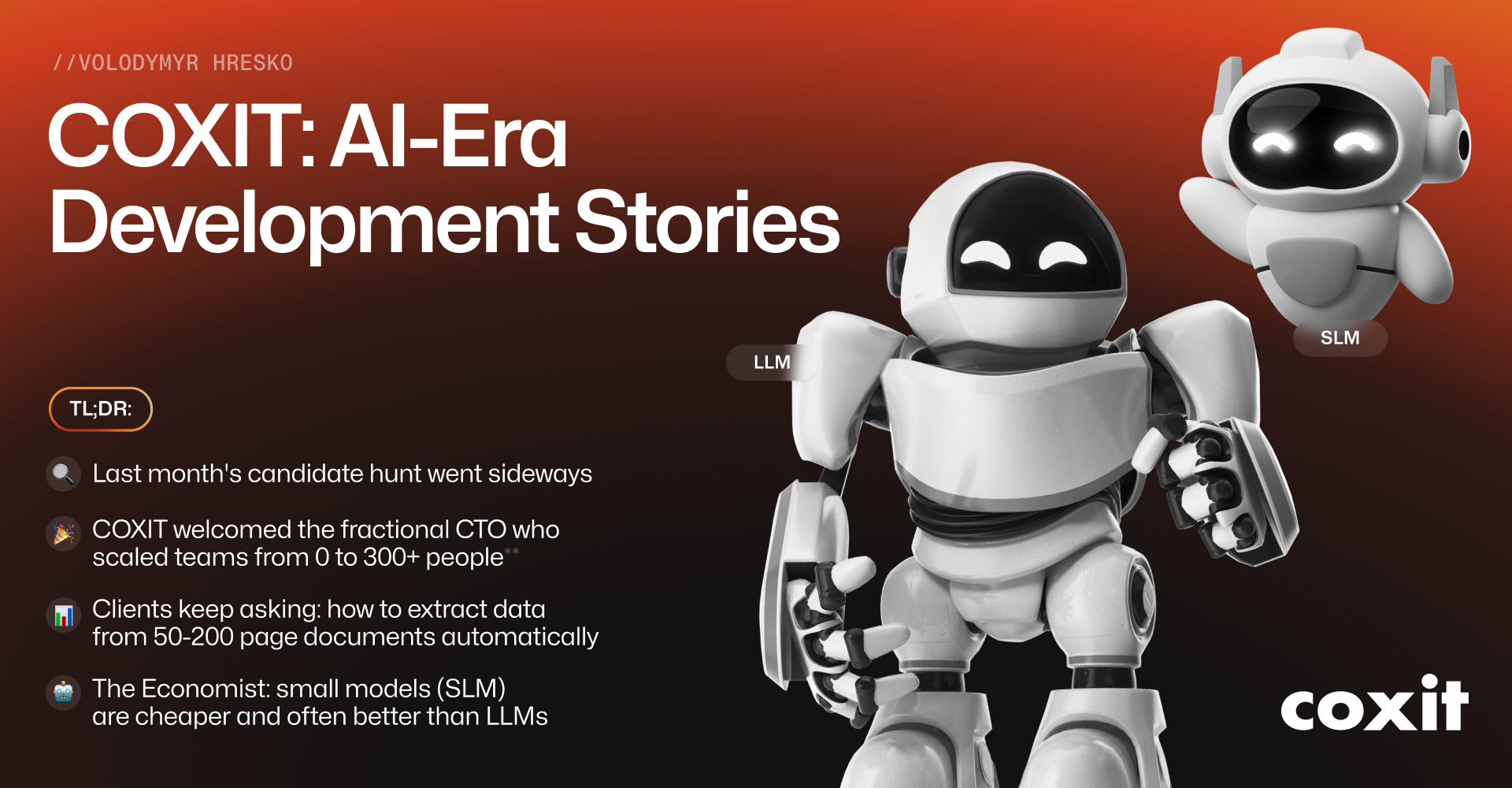
Two, small language models are often more practical than massive LLMs. Your HR chatbot doesn’t need to know advanced physics. Many businesses are realising they don’t need God-like intelligence. They need something tailored to their specific problem that actually works and doesn’t cost a fortune to run.
This lines up with what we’re seeing in real projects. The hype phase is over. Now it’s about building things that make business sense.
I also asked our Lead AI Engineer for his perspective on big LLMs:
The Economist is right — the “God-like LLM” era is fading. Businesses no longer want magic; they want measurable ROI. Big models got us here, but small, focused ones are what will keep delivering, automating real tasks like document parsing, QA, and data extraction. The shift isn’t about smarter models; it’s about smarter integration.
From my side, I see history repeating itself. Recently, a huge part of IT budgets went into code modernisation — cleaning up legacy systems from the dot-com era when software design wasn’t optimal. The same thing is happening now with GenAI. Companies are investing heavily, and while these large LLMs bring real value, they’re often overkill for narrow business problems. In a few years, we’ll be modernising again, replacing God-like LLMs with smaller, specialised models that do one thing well and fit naturally into business pipelines.
That’s September: two failed offers, one new CTO, and a dozen companies asking if AI can read their documents. (It can.)
Catch you in October,
Volodymyr
This issue first went out to subscribers of our LinkedIn newsletter, AI Era Development Stories, on October 13, 2025.