Arxion Takeoff Tool Audit

An audit of an AI takeoff tool to assess its current state, accuracy, and development roadmap.

Engineer reviewing an architectural floor plan on a monitor, with printed drawings on the desk Engineer reviewing an architectural floor plan on a monitor, with printed drawings on the desk

The client

Arxion is a tool that reads architectural drawings and counts the items an estimator needs to price a construction job.

The business goal

The team needed to understand how to improve the existing ML model accuracy, build an evaluation pipeline, and add more categories the tool could measure and detect.

The audit

Our team tested the tool on new drawings, reviewed the data handover, and assessed all 69 planned features against the existing code.

Key results

Evaluation strategy to measure LLM accuracy

ML model improvement plan

AI chat implementation architecture

Findings

Audit insights

[1]

Part of detection already worked

We tested the whole product. Doors, windows, and columns were detected but we couldn't verify the accuracy. The main problems were with walls and rooms, the detection seemed to struggle with them the most.

[2]

No evaluation pipeline

The tool had been tested on the same buildings it had learned from, so there was no reliable measure of how it would perform on a new project. The first priority was therefore measurement: establishing a reliable way to check accuracy before trying to improve it.

[3]

Most of the roadmap needed research

There were a lot of features planned. But of the 69 planned features, only 4 could be built on the existing architecture as is, 25 needed some rework, and 40 were not feasible.

[4]

We set up the ground truth

To build an evaluation system, we needed to set up the ground truth: a correctly made estimate or takeoff to evaluate the model's results against. For one building, that result already existed because an estimator had completed a full manual takeoff. So we agreed that the tool's output could be checked against it.

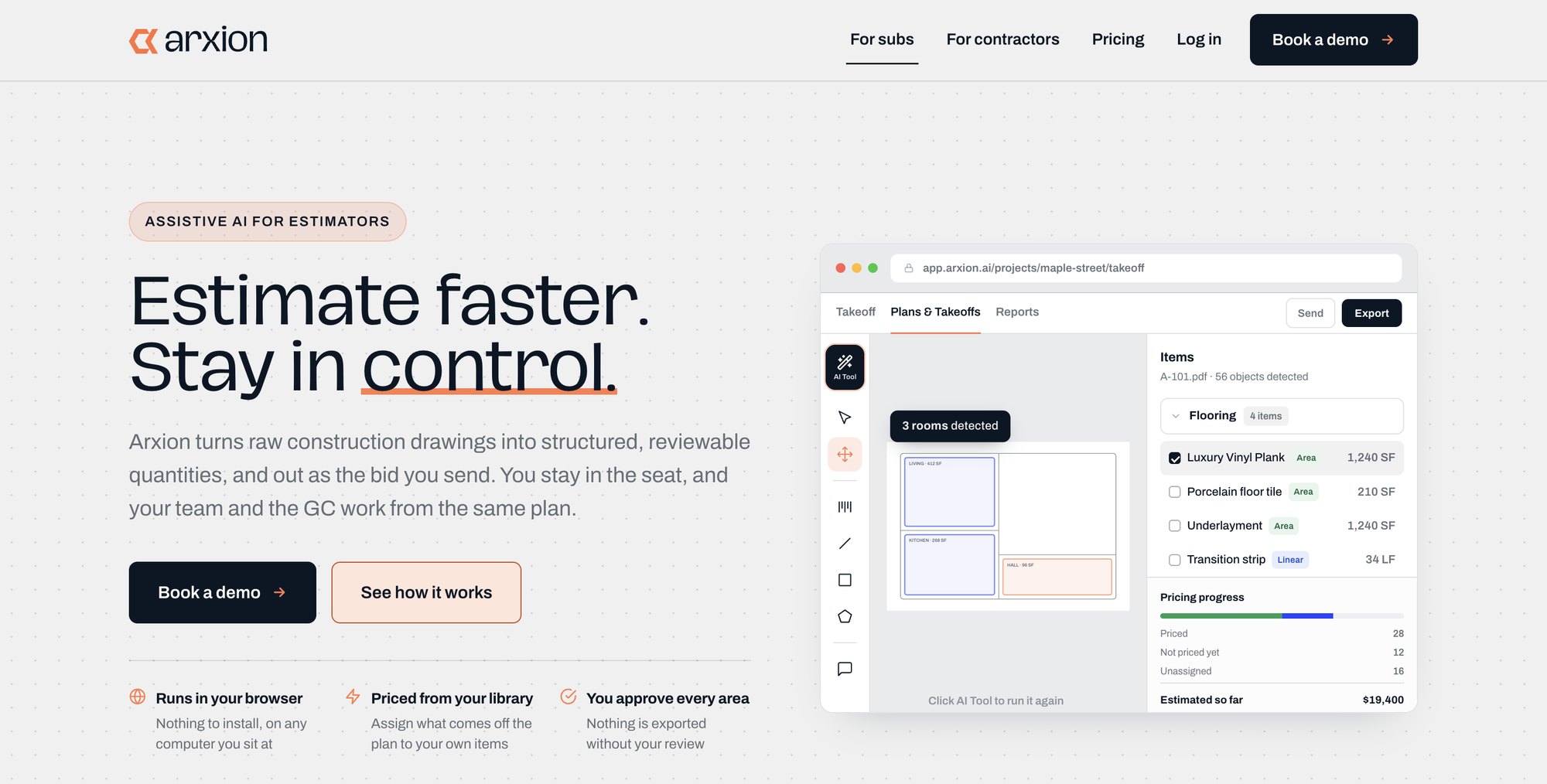
Arxion website: an AI takeoff tool for estimators, showing a floor plan with detected rooms next to a list of flooring items and quantities
Arxion, the AI takeoff tool we audited: it turns construction drawings into reviewable quantities for estimators.

Method

Audit process

[1]

Testing the accuracy

The previous team had measured the tool's accuracy only on drawings it had been trained on, so the figure said little about how it would behave on a new project.

The audit ran the tool on drawings it had never seen. Arxion got its first accuracy figure it could rely on, and a clear picture of which problems to fix first.

[2]

Checking the data and handover

The audit also compared what the previous team had delivered against what their plans described. Part of the training data was missing, and one building came with a takeoff already done by hand, a correct answer the tool could be checked against.

[3]

Building a future roadmap

There was a list of 69 features with no sense of their complexity.

The audit sorted them by effort and put them in order — make the current tool reliable first, then improve accuracy, then add new capabilities.

Deliverables

AI Audit Deliverables

[1]

Feature classification sheet

Every planned feature was rated by effort for the team to prioritize which are developed first.
[2]

Evaluation plan

We put together an evaluation strategy so the team can track accuracy and see progress of their detection features.
[3]

Chat architecture

A detailed plan on how to implement an AI assistant chat that answers users' questions about their construction drawings.

Frequently Asked Questions

  • An AI takeoff tool audit assesses the accuracy, data, ML models, architecture, and development roadmap of software that automatically extracts quantities and measurements from construction drawings. It helps teams identify what is working, what needs improvement, and which planned features are technically feasible.

  • We measure accuracy by testing the tool on drawings it has not seen before and comparing its output against a verified ground truth, such as a manually completed construction takeoff. This provides a reliable baseline for measuring model performance and tracking improvements over time.

  • The first step is establishing a reliable evaluation pipeline and ground truth dataset. Once accuracy can be measured consistently, the model can be improved by identifying its weakest detection categories, improving training data, and prioritizing the highest-impact ML changes.

  • Yes. AI and computer vision can be used to detect and count construction elements such as doors, windows, columns, walls, and rooms from architectural drawings. However, accuracy varies significantly by category, drawing type, and training data, so evaluation on previously unseen projects is essential.

  • We assess each proposed feature against the existing architecture, data, ML capabilities, and implementation requirements. Features can then be classified as feasible with the current system, requiring architectural or ML changes, or requiring further research before development.

Let's collaborate

Tell us a bit about your project or challenge, and we'll get back to you shortly.

Volodymyr Hresko Volodymyr Hresko Co-Founder & COO

Reach out directly

[email protected]
This field is for validation purposes and should be left unchanged.
Full name
By submitting the form, you agree to Coxit’s Privacy Policy.