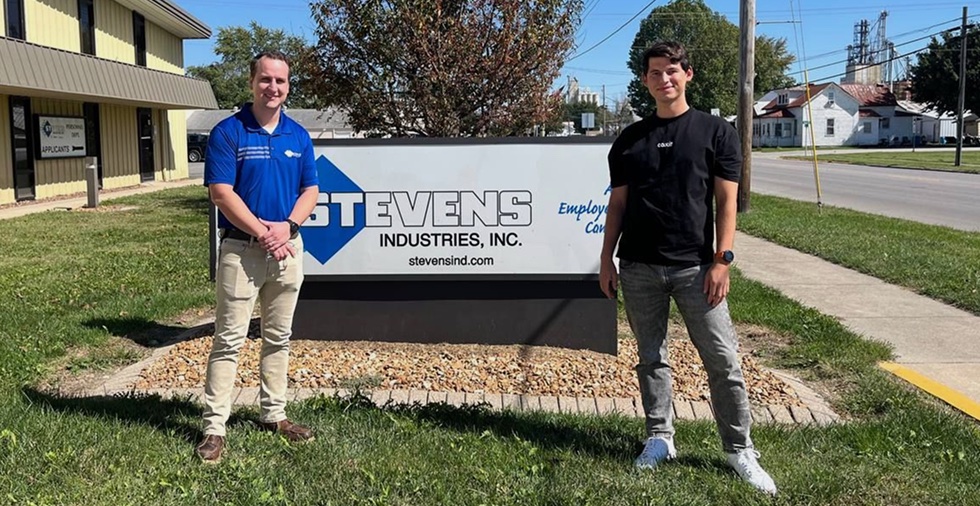
Our work with Stevens Industries, Inc. started in 2023 with one question: could AI actually read architectural drawings?
After a deep dive into their processes, we built a proof of concept — and it worked. That PoC turned into our biggest development project to date, and we are still coming up with new ideas alongside Stevens’ Continuous Improvement Manager, Ausby Curtis Garrard, and his team.
Who are Stevens Industries?
Stevens Industries is the largest manufacturer of commercial casework and architectural millwork in the United States. In 2015 the company was recognized as one of the fastest growing wood manufacturers in the country.
Last summer I got to visit their factory in person. Seeing their production in action — machines, materials, and people working together — was incredible. It made me appreciate just how much precision and craftsmanship goes into their work.
So let’s hear it from Curtis himself: how AI changed their estimation process, what they have learned, and what is next for the industry.
Meet Curtis Garrard, Continuous Improvement Manager at Stevens
Curtis is always driving innovation and trying to solve complicated business challenges. We have been working alongside him since 2023, and I can say he is one of the best professionals I know — always looking forward and planning big. Today I am giving him this space to share his AI development story.
Before implementing AI/ML, what challenges did you face with your estimation process?
Curtis: Like many trades and crafts within our industry, the role of an estimator is one that is built on knowledge and experience of what it takes to do the work they are responsible for estimating. Because of this experience, the learning curve is quite long for people just entering the role.
Additionally, in the case of our specific products where there is no straightforward way to automate all of the rules and logic, that experience is heavily relied on to produce custom level quotations for our customers. Because of these facts, we face the constant challenge of supply and demand to grow our business. In order to grow our business, we must estimate more, and this is hard to do when the talent required to supply the needed demand is not easy to find.
What made you decide it was time for an AI-powered solution?
Curtis: The goals of the business began to transform where we realized that if we wanted to estimate more to support a goal of greater sales, we had to figure out how to streamline workflows and look for outside the box solutions that might help us. Thinking outside of the box is where an AI solution began to come into mind.
After researching what was already available to the market, we found that there were tools for other crafts that already existed, but nothing that quite fit our use case. We knew then that the technology could help solve our problem, we just needed to find a way to create it since it wasn’t readily available.
How did the transition from manual to AI-powered estimation work?
Curtis: It transitioned slowly, and is still an ongoing transition. Changing the day-to-day processes of experienced team members is not an easy one, especially when they may not have the same technical understanding of what is possible with an AI/ML solution. It has taken a lot of teaching and showing to help establish the truth that utilizing an ML driven solution leads to a more efficient solution.
What results have you seen since adopting AI/ML?
Curtis: There have been several results that I would highlight.
Most notably, we began to fix our issue where we can now get through our estimating process more efficiently and therefore can support goals for higher sales with our existing staff. In some cases where the pre-estimating process could take between 2–3 hours, we now see it being completed in about 10 minutes by utilizing our new technology.
Indirectly, we’ve begun to benefit from a more technologically knowledgeable team as well. Because of the teaching required to help our team members see the vision we were working towards, they’ve begun to understand what capabilities actually exist and are now actually suggesting improvements to make our new solution even better.
How has this impacted the business overall?
Curtis: I would say we are still in the early adoption phases of the new technology, so the actual impact we’ve seen so far is still a small sample size. But overall, we’ve seen an increase in our pre-estimating and estimating processing time.
As we continue through the adoption phase and actually improve the ML side of our tool by continued use, this should help us to be able to increase our overall estimating capacity without having to hire additional resources. This impacts our business by allowing us to serve more customers without having to add cost into the business to do so.
What advice would you give to other manufacturers considering AI/ML?
Curtis: We are in an age of technology where if you can think it, you can do it.
Don’t be afraid to challenge your own assumptions about how you do work. This will help you explore thought processes like: “Is this the best way to do this?” It all starts with the ideas that are generated from that thought experiment. If the idea is good enough, execution of the idea can be planned.
But before jumping into the execution of the idea, involve your stakeholders early and often to help scope out your requirements and ideas as much as possible. This does several things: establishes buy-in to the idea before actually starting, helps fill in possible missing gaps in the current idea that should be considered, and helps lead to a more creative and complete scope of work for your project.
The output to this will be a well thought out idea that can be directly transferred to an executable path. As Thomas Edison once said, “Having a vision for what you want is not enough. Ideas without execution are hallucinations.”
The work behind this
The Stevens engagement is written up in three parts: the proof of concept that answered the “can AI read a drawing?” question, the Production Takeoff Tool that came out of it, and the Spec Book AI Agent that reads the specification books around each job.
I wouldn’t find a better way to finish this edition. As you know, I am always open to discussing new ideas and finding a way AI can optimize your business operations. Just get in touch and we can set up a quick meeting.
All the best,
Volodymyr
This issue first went out to subscribers of our LinkedIn newsletter, AI Era Development Stories, on March 18, 2025.